To ride Alpe d'Huez, start from Bourg d'Oisans early in the day, ride the steep first few kilometres well within yourself, count down the 21 bends, and keep eating and drinking all the way up. Fit lower gears than you use at home, carry a jacket for the top, and follow the Tour de France signs to the official finish. It is a long climb rather than a brutal one, so pacing matters far more than raw strength.
I ride most of my miles in the Peak District, where climbs are short and sharp. The Alpe is a different thing altogether. If you are still deciding between the big French climbs, I've compared them in is Alpe d'Huez or Mont Ventoux harder?. This post is the practical bit: how to actually ride it.
The climb at a glance
According to the official Alpe d'Huez resort figures, the climb starts at Bourg d'Oisans (717m) and finishes at Alpe d'Huez (1,860m). It is about 14.5km long with 1,121m of climbing, an average gradient of 7.9% and a maximum of 14%. There are 21 hairpins, numbered from 21 at the bottom down to 1 near the top, and each sign carries the names of Tour de France stage winners.
Where to start
The official start is just outside Bourg d'Oisans. Leave the main road at the edge of town, follow signs for Alpe d'Huez, and the start line is opposite the EDF gate, about 300m after the junction. There is a short flat stretch, and then the climbing begins almost straight away.
Bourg d'Oisans is the place to fill your bottles, buy food and use the loo. Once you start, it is uphill all the way.
How the climb unfolds
The first few kilometres: the steepest part
The first ramps are the hardest of the whole climb, with sections around 12%. This is where most people go too hard, because the legs are fresh and the excitement is high. The tourist office's own advice is to save your energy over the first two or three kilometres, and I would echo that.
La Garde and the middle bends
After bend 17 you pass through the village of La Garde, where the road eases for a short stretch. Use it to settle your breathing and have a drink. Then it steepens again for a while.
From Huez to the top
From the village of Huez there are about 6km to go, and this is where most riders find it easier to settle into a rhythm. Keep counting the bends down. Near the top you pass through a short tunnel, so a small rear light is worth having.
The official finish
At the top, the 21 bends end at the resort, but the Tour de France finish is a little further on. Follow signs for the tourist office, then the "Itinéraire du Tour de France" signs, to the official finish at the top of Avenue du Rif Nel. If you want to say you really did it, ride to the proper line.
Pacing the 21 bends
- Ride the first third easier than feels right. On the Alpe this matters even more, because the steepest ramps come first.
- Settle into a pace you could hold for a long time. If you cannot speak a short sentence, ease off.
- Use a heart rate or power target if you train with one, and stick to it.
- Break it into chunks. Count the bends down, aim for La Garde, then Huez, then the top.
- Stop if you need to. There is no shame in a pause for a photo and a drink.
Training for it at home
If you live somewhere with short hills, you can still prepare well.
- Ride repeats of your longest local climb, holding a steady effort rather than sprinting each one.
- Build up to long, steady rides so a climb that takes well over an hour does not feel strange.
- Practise eating and drinking while climbing, not just on the flat.
- Practise descending on hairpins if you can find them, so the way down is not a shock.
What to eat, drink and carry
Food and drink
- Eat a proper breakfast before you start, then keep eating small amounts on the way up.
- Carry two full bottles and fill them in Bourg d'Oisans.
- In summer it can be hot in the valley, so think about electrolytes as well as water. I've written more on the best drink for long distance cycling and the best things to eat on long rides.
- Take a card or a little money for a drink at the top.
Clothing
- A windproof or light jacket for the summit and the descent. It is cooler at the top than in the valley.
- Arm warmers and long finger gloves for the way down, especially early or late in the day.
- Sun cream and sunglasses.
Tools
Spare tube, tyre levers, a pump or CO2, a multi tool, your phone and some ID.
Gearing in plain terms
You do not need a special bike, but you do want low gears. For most riders that means a compact chainset and a wide range cassette, so you can keep turning the pedals rather than grinding. If in doubt, go easier. Nobody ever finished the Alpe wishing they had harder gears. A local bike shop can tell you what will fit your bike.
When to go
The main cycling season runs through the summer, and July can be very busy around Tour time. Whenever you go, start early. You get cooler air, fewer cars and more time if something goes wrong. Check the weather and the road conditions before you set off.
Getting back down safely
The descent is part of the ride. Put your jacket on at the top, take the hairpins steadily, brake before the bend rather than in it, and watch for cars, motorbikes and riders coming up. Turn your rear light on for the tunnel. Check your brakes and pads before the trip.
A souvenir on the day
From May to September, the Alpe d'Huez tourist office issues climb certificates for riders who want their time made official, for a symbolic €1 which goes to charity. It is a nice extra to bring home.
If you still have legs at the top, the road on to Lac Besson is a popular extra, around 8km there and back.
Turn your climb into a print
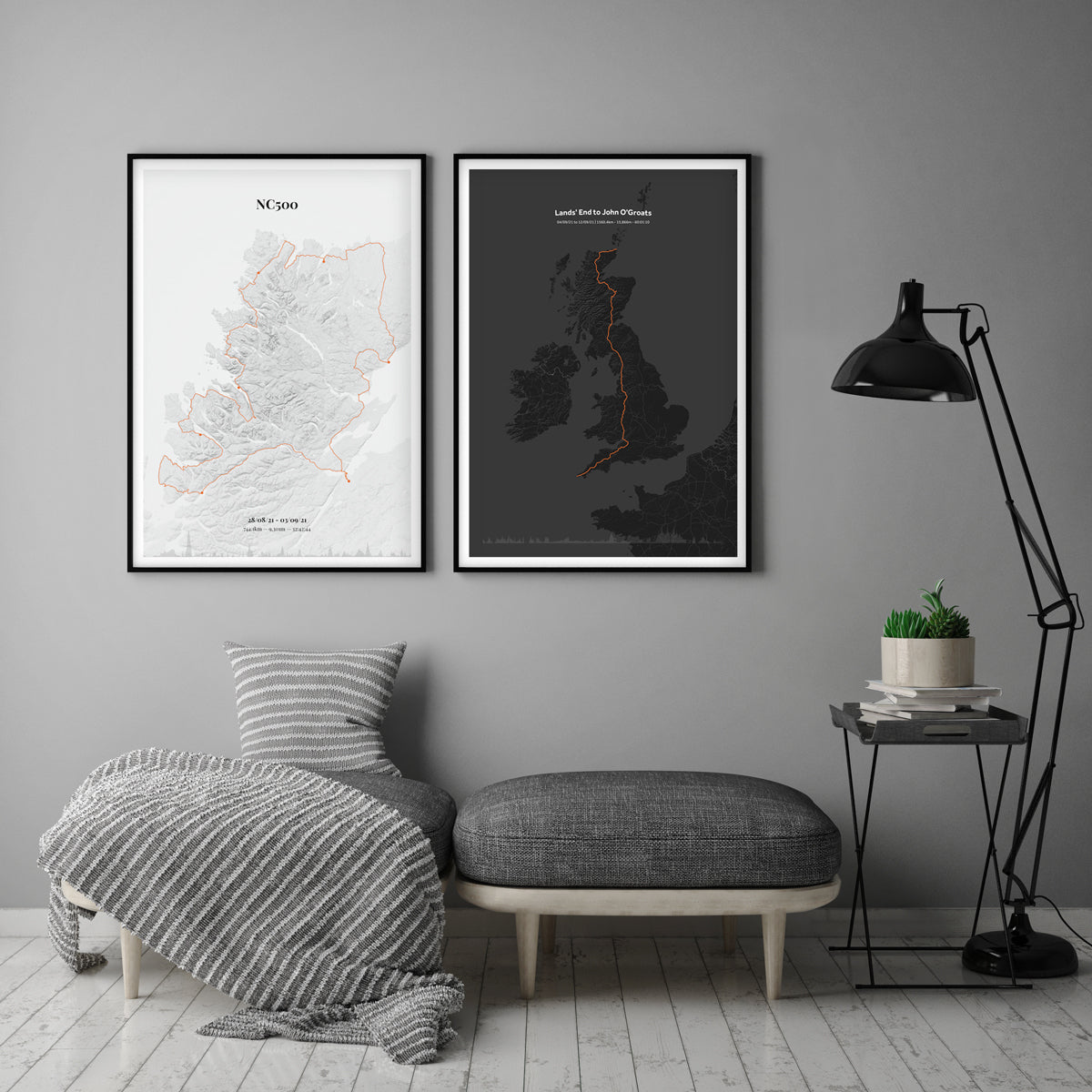
Once you have done it, you will want to remember it. If you recorded the ride on Strava or a bike computer, you can turn it into a map print with your time, distance and elevation using the map builder. Add your name and the date, check the design, and it is printed in the UK. If you rode a few climbs on the trip, they can all go on one print. My Strava poster design guide has tips on which stats to show (elevation is usually the hero number for a climb).
If you would rather have a classic poster of the climb itself, there is an Alpe d'Huez poster in the Tour de France collection. A poster of the Alpe next to a map of your own ride makes a nice pair.
FAQ
How long does it take to ride Alpe d'Huez?
It depends entirely on your fitness and pace. The record, set by Marco Pantani in 1997, is 37 minutes 35 seconds according to the resort. Most amateurs take a lot longer, so ride at your own pace and enjoy it.
How hard is Alpe d'Huez?
It is about 14.5km at an average of 7.9%, with the steepest sections in the first few kilometres. It is hard, but steady pacing and low gears make it achievable for plenty of ordinary club riders.
Where does the Alpe d'Huez climb start and finish?
It starts just outside Bourg d'Oisans, opposite the EDF gate, and the official Tour de France finish is at the top of Avenue du Rif Nel in the resort.
What gears do I need for Alpe d'Huez?
Low ones. A compact chainset with a wide range cassette suits most riders.
Keep the memory
The Alpe stays with you. If you have ridden it, or you are planning to, think about how you will remember it. You can start building a print of your climb in the map builder.